
The flexible future of solar energy
The challenge
Conventional solar panels are mostly heavy and rigid, and their installation is best suited to rooftops or ground frames, which limits their use in domestic settings. What’s more, while they have become a vital source of clean energy, they are not without their environmental limitations and traditional manufacturing processes are incredibly resource and energy intensive.
A new generation of solar cells, organic photovoltaics (OPV), could change how and where we are able to generate renewable energy. These solar cells are flexible, lightweight, and semi-transparent, meaning they can be used on almost any surface – including windows, curved surfaces and even wearable electronics. OPV can also be manufactured using earth-abundant materials, without the need for heavy and rare-earth metals, and with a much lower material and energy input than conventional silicon photovoltaics. This opens the door to rapidly advancing how solar panels are deployed, while significantly reducing their environmental footprint.
This is incredibly promising. However, while lab testing has shown that OPV devices are able to convert more than 20% of sunlight that makes contact with the cells into usable electrical energy – not far from the conversion rate of standard commercial solar panels – performance currently declines as small lab devices are scaled up into large panels, and most commercial OPV modules are only able to convert about 10% of sunlight in real-world settings.
The innovation
Closing this gap is key to unlocking the full potential of this technology – and this is exactly what Professor Moritz Riede aims to do. With the Green Future Fellowship funding, he is using AI and robotics to test thousands of OPV materials and designs automatically and at high speed, with the goal of improving real-world OPV performance to 20% and above. He aims to accelerate the technology’s commercialisation, helping the UK achieve its net zero goals, and advancing a fair clean energy transition everywhere.
The innovator
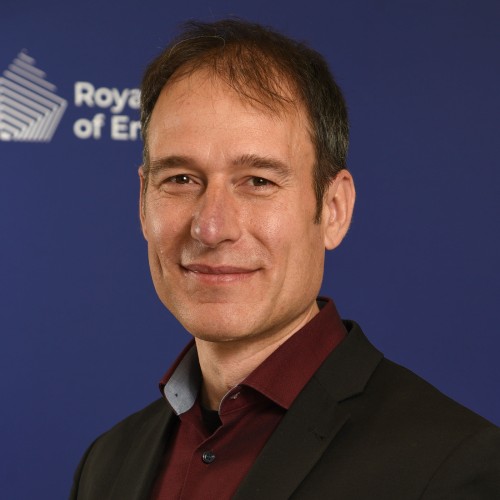
Professor Riede is Professor of Soft Functional Nanomaterials at the University of Oxford. His passion for physics and renewable energy technologies began at school, sparked by an inspiring teacher. As an undergraduate, he began to explore OPV, and since then has dedicated his work to the field, becoming increasingly convinced of its potential to be a truly disruptive and equitable technology.
Imagine solar panels that could go almost anywhere. Organic solar cells could turn everyday surfaces into clean power.
Related content
View all programmesSupport for research
The Academy runs a number of grants to support excellent researchers carry out engineering activities and to enable clo…
Green Future Fellowship
The Green Future Fellowship programme supports academics, entrepreneurs and innovators to develop and scale up their br…