
Transforming carbon dioxide from waste to watts
The challenge
Modern life depends on reliable energy supply to meet everyday needs – and the vast majority of this energy comes from burning fossil fuels like gas, oil and coal, which produces carbon dioxide (CO₂). Dr Sharon Velasquez-Orta is asking: how can CO₂ become a source of fuel, rather than a byproduct of burning fossil fuels?
We have very limited methods for negating CO₂ emissions. The most-used approach is carbon capture and storage (CCS), whereby CO₂ is captured and stored underground. However, CCS has limited impact and comes with many challenges.
The innovation
Dr Velasquez-Orta is exploring an alternative to CCS that doesn’t just contain CO₂ but transforms it into new and useful products. Using microbes and bioelectrolysis, she is developing a technology to convert CO₂ into clean fuel, which will then be used to upgrade biogas – a renewable energy source produced from food waste, manure and other organic materials – into a higher-quality fuel.
Biogas normally contains a large volume of CO₂, which lowers its energy content. By converting this CO₂ into fuel, the energy content of biogas is increased, making it more powerful and reducing CO₂ emissions from its use. If widely adopted, this approach could reduce emissions by approximately 3.1 million tonnes per year of CO₂, supporting the UK to meet net zero ambitions.
Through the Green Future Fellowship funding, Dr Velasquez-Orta aims to move her research beyond the laboratory and into real-world testing environments, using existing infrastructure to explore how the technology could work at scale.
The innovator
Having grown up in Mexico City when it was considered one of the most polluted urban areas in the world, Dr Velasquez-Orta’s work is shaped by a long-standing commitment to environmental improvement. Following university, she worked as a graduate engineer at a major food manufacturing company and saw first-hand how industries struggled to reduce CO₂ emissions because of a lack of technology to support them. This led her to return to academia to develop new systems that could benefit the environment while also offering economic value. Today, she is a Senior Lecturer of Sustainable Chemical Engineering at Newcastle University.
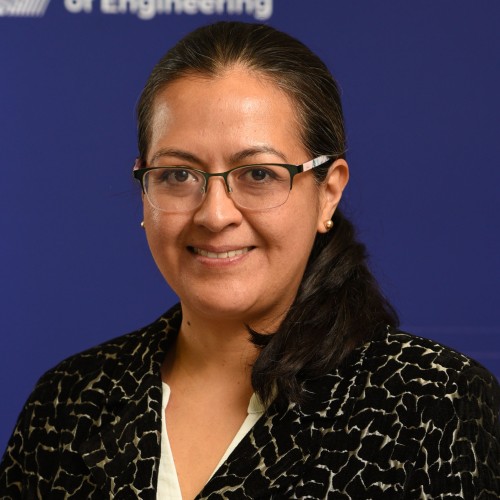
Achieving net zero requires more than reducing emissions; it requires rethinking our approach to carbon dioxide, transforming it from pollution to power.
Related content
View all programmesSupport for research
The Academy runs a number of grants to support excellent researchers carry out engineering activities and to enable clo…
Green Future Fellowship
The Green Future Fellowship programme supports academics, entrepreneurs and innovators to develop and scale up their br…