
They are all winners of the Academy's Young Engineer of the Year competition and will receive their prizes at the Academy Awards Dinner in London on Wednesday 8 July.
The 2026 Young Engineers of the Year are:
- Brogan MacDonald, Head of Sustainability in Building Structures at Ramboll UK
- Laura Tuck, Research and Development Lead at The Washing Machine Project
- Dr Douglas Brion, Co-founder and CEO of Matta
- Dr Aakeen Parikh, Research Manager for the Vehicle Futures Hub, Imperial College London
- Alexia Williams MBE, Technical Lead at Rolls-Royce
The overall winner, Brogan MacDonald, will also receive the Sir George Macfarlane Medal for her work on finding the best ways to reuse building materials like concrete and steel, to make the construction industry more sustainable, aiding the restoration and protection of the natural environment.
Luke Logan FREng, Chair of the Academy’s Awards Committee, said:
"Congratulations to this year’s Young Engineers of the Year. By using data to shape how we build our infrastructure and make vehicles more sustainable, advocating for engineering to reach those who are underrepresented and underserved, and finding innovative ways to apply AI in the manufacturing industry, these engineers are challenging and creating new perceptions of what engineering can be and who it can help."

Brogan MacDonald, Head of Sustainability in Building Structures at Ramboll UK
Brogan MacDonald is an outstanding leader within Ramboll’s UK Sustainability Leadership Group, who helps shape their strategy for sustainable change and drives delivery of low‑carbon, resource‑efficient outcomes across the built environment.
A Chartered Civil Engineer and Chartered Environmentalist, Brogan champions material reuse, embodied‑carbon reduction and regenerative design principles. Her work includes the creative retrofit and retention of the Westbury Hotel over four years, leading the
technical design and project management. By auditing the existing reinforced-concrete frame and challenging the demolition brief, she enabled the reuse of the existing frame and saved 5,000 tonnes of demolition material and 3,500 tonnes of embodied carbon.
As well as driving the company’s ConcreteZero and SteelZero commitments that aim to
decarbonise systems and reduce waste, part of her impact includes leading the development of Ramboll’s UK structural embodied-carbon calculator. This is a tool that has been applied to over 100 projects, with many assessments found on Ramboll’s open-sourced carbon database CO2mpare.
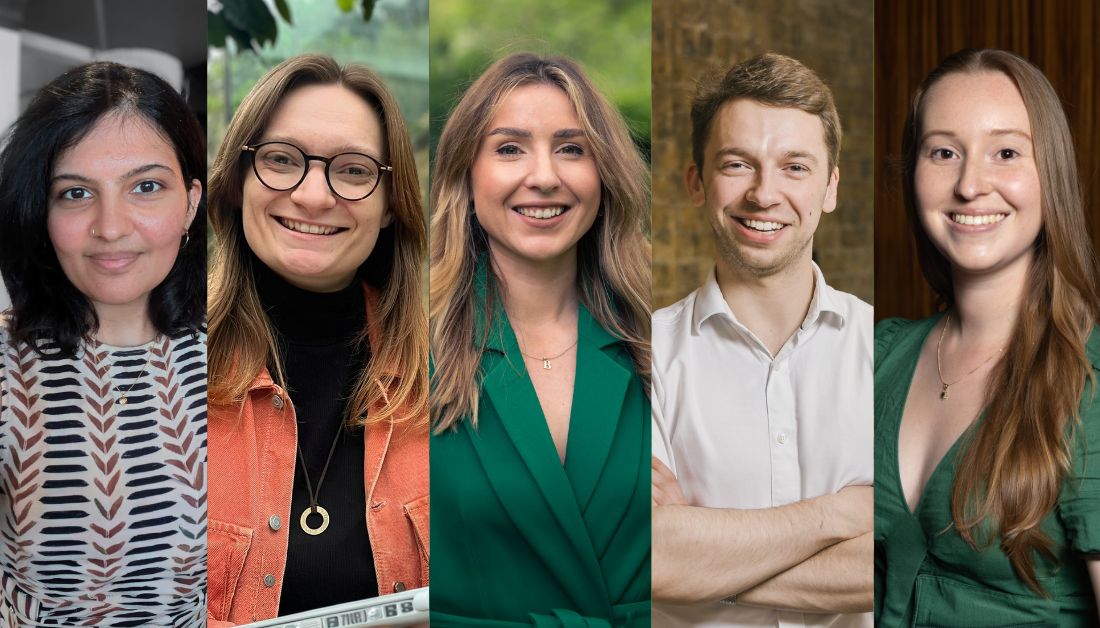
Young Engineers of the Year (from left to right: Dr Aakeen Parikh, Laura Tuck, Brogan MacDonald, Dr Douglas Brion, Alexia Williams MBE)
Outside work, Brogan is a strong advocate for encouraging women in STEM and sustainability, mentoring and inspiring the next generation.
Will Arnold, Head of Sustainable Materials at the Useful Simple Trust, said:
“Brogan exemplifies the kind of leadership our industry urgently needs. She has that rare ability to challenge convention and inspire change – not just among peers, but among senior professionals too. She has consistently demonstrated that ethical leadership and climate action are inseparable, and that engineers must be equipped not only with tools and data, but with the courage to ask difficult questions.”
Laura Tuck, Research and Development Team Lead at the Washing Machine Project
With the Washing Machine Project, Laura designs manual washing machines for women and girls in underserved communities who often carry the challenging workload of handwashing clothes. Manual washing machines have been distributed in Uganda, four machines were sent to hospitals in Gaza and over 56,000 people have already been reached. They have a partnership with Whirlpool Corporation and aim to help at least a million people by 2030.
The device uses a hand-cranked drum to wash clothes effectively using minimal water and without electricity. By reducing the time and physical strain of laundry, as well as saving water, this manual washing machine has the potential to help millions of girls and women across the world in settings like refugee camps and underserved communities where access to running water and electricity is limited.
Dr Helen Liang, Creative Consultant in Insight and Innovation, LEGO® Serious Play® Facilitator, and Teaching Fellow for the Faculty of Engineering & Design at the University of Bath, said:
“During her time at the Washing Machine Project, Laura has grown an engineering team balancing technical leadership whilst navigating the challenges of being a start-up business that continues to go from strength to strength.
“From functioning with limited resources, field testing in challenging environments and navigating complex, global supply chains; she is a resilient leader that puts compassion and human needs at the heart of what she does.”
Dr Douglas Brion, Co-founder and CEO of Matta
Through his company Matta, Doug Brion is giving factories the ability to autonomously sense defects, reason through root causes, and ultimately optimise production in real time. Matta’s industrial AI translates this physical reality into a single, queryable intelligence platform for the entire enterprise. By turning the chaos of real-world production into structured data, Matta solves the critical bottlenecks of modern industry: rapidly bringing complex new products to market and ensuring they scale reliably without waste.
To achieve this, Matta’s system is designed to learn the physical rules of any production line within days. By deploying a network of sensors to capture ground truth, the AI automates mission-critical measurements and digitises the invaluable tacit knowledge of the workforce. This continuous flow of real-world data powers the ‘Matta Agent’, a conversational interface that allows everyone from line operators to senior managers to instantly query production metrics and resolve bottlenecks. Driven by accelerating enterprise demand, Matta is now deploying into two new factories every month, backed by $14 million in seed funding.
Professor Tim Minshall, Dr John C Taylor Professor of Innovation, Head of the Institute for Manufacturing, said:
“Dr Brion is an exceptional young engineer, whose work has already demonstrated remarkable impact and is on a trajectory to deliver substantial industrial and societal benefits. He is immensely passionate about engineering and has a genuinely exceptional ability to engage and inspire others with his enthusiasm and charisma."
Dr Aakeen Parikh, Research Manager for the Vehicle Futures Hub, Imperial College London
At the Vehicle Futures Hub, Dr Aakeen Parikh leads on collaborative projects, bringing together academia and industry to accelerate the deployment of future vehicle technologies. Her work supports the UK’s transition to cleaner transport by helping to turn research into practical solutions that can be adopted at scale. Her passion for developing innovative solutions to address key global issues like climate change and social injustice inspired her work on The Minazi Impact, where she leads the development of environmentally sustainable solutions for progressing female health and well-being.
Aakeen also leads on the Sanitary Pad Project in Rwanda, collaborating with a grassroots NGO, Dufatanye Organisation, to produce reusable sanitary pads from local waste resources. The project has distributed over 3,000 sustainable sanitary pads to women and girls in rural Nyanza, Rwanda, upcycling over 100 waste banana trees and generating engineering employment for five women. Aakeen also launched a Menstrual Hygiene Campaign across Rwanda, delivering talks to over 1000 members of the community and featuring on Rwanda News.
Devlyn Lalonde, Senior Global Manager at the Royal Society for the Encouragement of Arts, Manufactures, and Commerce, said:
“Dr Parikh’s combination of technical ingenuity, social purpose, and business acumen sets a rare standard for engineering leadership. By bridging the worlds of research, entrepreneurship, and social innovation, she reflects an unwavering commitment to engineering’s highest purpose: to improve lives and build a more sustainable future.”
Alexia Williams MBE, Technical Lead at Rolls-Royce
Alexia Williams is an accomplished engineering leader who has worked across the whole Rolls-Royce Defence Portfolio. She develops and delivers through-life technical strategies to improve the in-service performance and reliability of key assets.
Alexia organised the first ever Rolls-Royce Defence Family Open Evening in Bristol, an event that welcomed over 1,500 employees and their families to experience the world of engineering. Through hands-on exhibits, live demonstrations, and career conversations, the event opened the possibilities of STEM to young people while deepening community engagement. She has also pioneered predictive maintenance approaches using asset data, transforming it into actionable insights that are now being embedded into business-as-usual operations. Her creativity has introduced technologies such as the Laser Doppler Vibrometer to test the safety and effectiveness of new tools and technologies, and 3D-printed tooling for validation and training. These innovations have improved reliability and reduced costs for Rolls-Royce.
Visiting Professor Ben Hovell, Rolls-Royce Engineer and Royal Academy of Engineering Visiting Professor at University of Aberdeen, said:
“Alexia is an exceptional young engineer. Her dedication to promoting engineering, especially to young women, has helped many people build confidence and see themselves as engineers. She embodies the very spirit of this award – technical brilliance, resilience in the face of adversity, and a deep commitment to shaping the future of engineering.”
Notes for editors
- The Royal Academy of Engineering makes five awards of £3,000 each year to UK engineers in full-time higher education, research or industrial employment, who have demonstrated excellence in the early stage of their career (less than ten years since graduation from their first degree in engineering or equivalent qualification).
- From these five awardees, the Academy’s Awards Committee selects an overall winner who, in addition to their cash award, receives the Sir George Macfarlane Medal, which is named after Sir George Macfarlane, a Founder Fellow of the Fellowship of Engineering, later the Royal Academy of Engineering. His groundbreaking work during the Second World War enabled the introduction of radar for guiding bombers and spotting U-boats. After the war he was instrumental in guiding government research and overseeing the introduction of optical fibre and digital technology into telecommunications. His work with the Academy focused on engineering education and links between universities and industry.
- Annual Awards Dinner 2026: This year’s Royal Academy of Engineering Award. The event will also celebrate the winners of other awards and prizes including the MacRobert Award and The Princess Royal Silver Medals. Awards Dinner 2026.
- The Royal Academy of Engineering creates and leads a community of outstanding experts and innovators to engineer better lives. As a charity and a Fellowship, we deliver public benefit from excellence in engineering and technology and convene leading businesspeople, entrepreneurs, innovators and academics across engineering and technology. As a National Academy, we provide leadership for engineering and technology, and independent, expert advice to policymakers in the UK and beyond. Our work is enabled by funding from the Department for Science, Innovation and Technology, corporate and university partners, charitable trusts and foundations, and individual donors.