
The award celebrates an outstanding personal contribution made to UK engineering by an early to mid-career engineer resulting in market exploitation. This year’s winners have used lasers and optical fibres to develop a new way of capturing information from space, created software that makes batteries more sustainable, and applied AI to make touch-responsive materials.
The recipients of The Princess Royal Silver Medals for 2026 are:
- Dr Ian Campbell, Co-founder of Breathe Battery Technologies
- Dr Liucheng Guo, Co-founder and Chief Technical Officer of TG0
- Professor Robert Thomson FREng, Professor of Photonics at Heriot-Watt University
Luke Logan FREng, Chair of the Academy’s Awards Committee, said:
“This year’s winners of The Princess Royal Silver Medal have each pushed the boundaries of engineering. Through their research and innovative ideas, they have supported the UK in being a leader in engineering and sustainability, making significant contributions to our national economy through inspiring entrepreneurship and collaboration.”

Dr Ian Campbell, Co-founder of Breathe Battery Technologies
With his company Breathe Battery Technologies, Ian has discovered how to extract the most potential from batteries by improving the charging process.
By simulating the internal workings of batteries, the team at Breathe created software that gives insight on the electrochemistry and other issues that can reduce their efficiency. The software helps manufacturers to optimise battery charging and design and can be integrated without hardware changes. By extracting better performance from existing battery chemistries, this technology has the potential to reduce electronic waste and accelerate the transition to cleaner, electrified transport and devices.
Ian achieved his PhD at Imperial College London focusing on lithium-ion batteries. Founded in 2019 as a spin-out from Imperial College London, Breathe Battery Technologies has now grown to operate the largest battery testing facility in London and has raised more than $33 million in funding. They have also collaborated with large corporations such as Volvo Cars, OPPO and Polestar.
Professor Ricardo Fernando Martinez-Botas, Head of the Department of Mechanical Engineering at Imperial College London, said:
“The market exploitation Ian has realised reflects the importance of the technology as we transition society from combustion to cleaner electric transport. His personal contributions to the battery and clean energy field have had a transformational impact on UK engineering and sustainability, placing the country at the bleeding edge of a competitive international race in battery technology and electrification.”
Dr Liucheng Guo, Co-founder and Chief Technical Officer of TG0
Liucheng has developed a first-of-its-kind 'AI for Sensing' approach for electronic products, giving machines a more human-like sense of touch and enabling more intuitive interaction.
Most electronic products, from robotic skins to car seats, have individual power buttons alongside multiple sensors and parts for general use. TG0’s patented technology replaces these separate parts with intelligent, touch-sensitive materials that are powered by embedded AI, resulting in simpler, lower-cost and more sustainable designs. The system can detect signal changes from different components, for example, detection of pressure, location, direction and movement of touch. This mimics a more human way of perceiving and processing tactile information, creating more user-centric experiences.
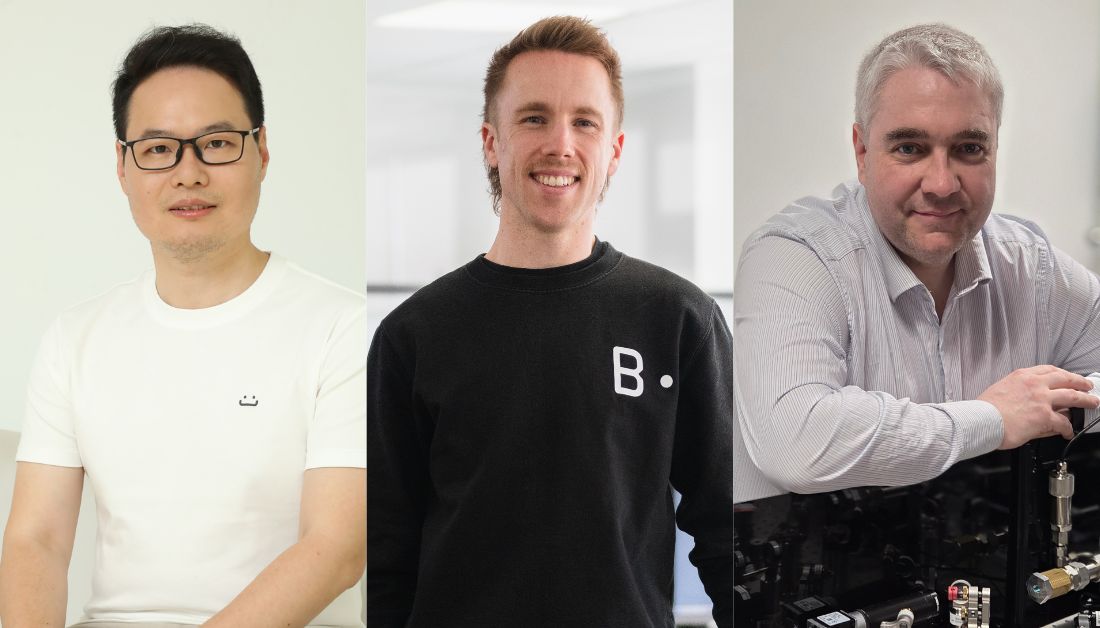
This year's winners of the Princess Royal Silver Medal (from left to right): Dr Liucheng Guo, Dr Ian Campbell and Professor Robert Thomson.
TG0 has sold directly to consumers, developing a VR controller called ‘etee’ that could have applications in gaming and medicine. TG0 has been recognised as one of Deloitte UK's Fast50 fast growing tech companies and has won the GBx Best in British Tech Award: Deep Tech Innovation.
Liucheng was chosen to join the Academy’s Shott Scale Up Accelerator where he graduated as an SME Leader in 2019 and is currently an Industrial Fellow of the Royal Academy of Engineering.
Professor Wei Liu, Professor of Design Engineering and Innovation at King’s College London, said:
“Dr Guo’s pioneering approach to low-resource, sustainable embedded AI has immense potential for growth. His intelligent materials are being used in medical wearables, adaptive robotics, and next-generation sustainable manufacturing – fields that will define the next decade of engineering innovation. He exemplifies the spirit of this award - engineering that transforms ideas into impact and inspires a more sustainable, intelligent world.”
Professor Robert Thomson FREng, Professor of Photonics at Heriot-Watt University
By applying photonics to astronomy, Robert has invented the integrated photonic lantern, redefining what is possible in fibre optics.
Conventional optical fibres carry data as pulses of light. Across longer distances, these are typically single mode fibres that rely on light having a single pattern. Using optical fibres to collect light in astronomy has proved difficult because most telescopes create signals composed of multiple patterns of light, all travelling at different speeds. This leads to a loss of signal and increased noise, corrupting the data.
To overcome this, Robert developed a new type of photonic lantern small enough to be mass produced and integrated into telescopes. Using ultrafast laser pulses, tiny 3D light-guiding paths are carved inside glass, creating pathways that smoothly connect the multimode light collection to single mode devices, preserving the information as it travels. Applications of Robert’s photonic lantern range from capturing starlight to look for evidence of exoplanets to zooming in on cells inside the body, and next generation telecommunications.
Robert developed the first integrated photonic lanterns during his Advanced Fellowship funded by the Science and Technology Facilities Council, part of the UKRI and he co-founded a company called Optoscribe, which was later acquired by Intel.
Professor Stephen McLaughlin, Deputy Principal for Research and Impact at Heriot-Watt University, said:
“Robert Thomson's work in ultrafast laser microfabrication has redefined the art of the possible in photonics. His seminal inventions – the 3D waveguide interconnect and the integrated photonic lantern – are not only academic breakthroughs but transformative for industry.”
Notes for editors
- The Princess Royal Silver Medal was established as the Royal Academy of Engineering Silver Medal in 1994 to recognise an outstanding and demonstrated personal contribution to British engineering, which has resulted in successful market exploitation, by an engineer with less than 22 years in full time employment or equivalent on 1 January in the year of award and who will normally be Chartered. In 2021, the Academy’s Royal Fellow, HRH The Princess Royal, generously allowed the Academy to rename its Silver Medal, to honour Her Royal Highness’s outstanding contributions as a Royal Fellow and as an exceptional champion for engineering, including as a vocal and long-standing supporter of women in engineering and science.
- Awards Dinner 2026: This year’s Royal Academy of Engineering Awards Dinner takes place in London on Wednesday 8 July. The event will also celebrate the winners of other awards and prizes including the MacRobert Award and the Rooke Award for public promotion of engineering.
- The Royal Academy of Engineering creates and leads a community of outstanding experts and innovators to engineer better lives. As a charity and a Fellowship, we deliver public benefit from excellence in engineering and technology and convene leading businesspeople, entrepreneurs, innovators and academics across engineering and technology. As a National Academy, we provide leadership for engineering and technology, and independent, expert advice to policymakers in the UK and beyond. Our work is enabled by funding from the Department for Science, Innovation and Technology, corporate and university partners, charitable trusts and foundations, and individual donors.
For more information please contact: Kunashe Gonye at the Royal Academy of Engineering Tel. +44 203 839 3433; email: [email protected]