
Top UK engineering prize shortlist includes:
- London-based assistive technology company, WeWALK
- Northumberland-based rail safety innovator, Transmission Dynamics
- Oxford-based genomic sequencing pioneer, Oxford Nanopore Technologies
Today the Royal Academy of Engineering has announced the three finalists for the 2026 MacRobert Award, the longest-running and most prestigious prize for UK engineering innovation. This year’s shortlist recognises transformative developments in assistive technology, rail safety and genomic sequencing from three different areas of the UK - London, Northumberland and Oxford.
One year on from the publication of the Government’s Industrial Strategy, this year’s finalists underline the UK’s strength as a global leader for innovation, with breakthroughs from different fields of technology, each making a lasting global impact.
For over 55 years, the MacRobert Award has recognised engineering that combines commercial viability with genuine societal benefit, celebrating innovations that have shaped industries and changed lives.
The MacRobert Award judging panel selected three finalists who represent the very best of British engineering innovation, including:
WeWALK Smart Cane: Closing the gap for visually impaired people through smart technology
For decades, the 295 million people worldwide living with visual impairments have relied on tools – including white canes – which have remained largely unchanged by innovation and are ineffective at detecting some obstacles. The WeWALK Smart Cane, designed in partnership with RNIB (Royal National Institute of Blind People) and Imperial College London with input at every stage from blind and low vision people, closes this gap by incorporating smart technology. Using sounds and vibrations, it alerts users to obstacles and allows users to identify an approaching bus, check directions and complete journeys – all delivered through the cane.

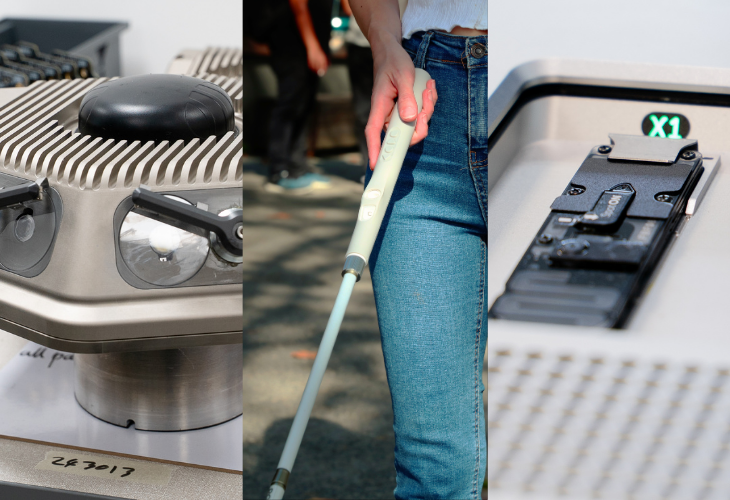
Transmission Dynamics: Revolutionising rail safety standards with intelligent detection and prevention technologies
Faults in rail overhead lines are difficult to detect before they cause damage - leaving operators in a cycle of reactive repairs rather than proactive prevention and costing the taxpayer millions in delays and disruption. In the worst cases, undetected faults pose a serious risk to passenger safety.
Northumberland-based Transmission Dynamics has created a groundbreaking technological solution that addresses this: PANDAS-V, a wireless real-time, AI-powered video capture device, which generates analysis of overhead line conditions as faults emerge - giving engineers the information they need to intervene before potential accidents and disruption occur.
Oxford Nanopore Technologies: Expanding access to real-time genomic analysis
For over 20 years, genomic sequencing relied on slow, costly technology that was out of reach for most of the world. Oxford Nanopore has pioneered an alternative: nanopore-sensing technology that reads DNA and RNA strands directly and in real time - in high-throughput laboratories, in the field at the site of disease outbreaks, and even aboard the International Space Station. The result is faster access to rich genomic information, supporting work across research, public health, the environment and industry.
Announcing the finalists, Dr Alison Vincent CBE FREng, Chair of the MacRobert Award judging panel, said: “The MacRobert Award exists to celebrate engineering that makes a genuine difference - and this year's finalists do exactly that. From the streets of London to the railways of Northumberland and the laboratories of Oxford, these three innovations show that world-class engineering can be found across the whole of the UK.
“What unites this year's finalists is their ability to take a complex problem and solve it with elegant, deployable technology - technology that is already providing real-world benefits, saving time and money, and in some cases, saving lives. That combination of commercial rigour and genuine societal benefit is what the MacRobert Award has stood for since it was created in 1969, and these finalists embody it completely. This year carries a special significance for the Royal Academy of Engineering as it marks its 50th anniversary. Through the winners of this special award, we can reflect on more than five decades of championing the engineers and innovations that have shaped our world - and look ahead to the next fifty. This year's finalists represent the kind of bold, purposeful engineering that will define that future.”
The three finalist teams are competing for a gold medal and a £50,000 prize, as well as a luxury weekend at the MacRobert estate in Aberdeenshire.
The Academy will announce the winner at its annual Awards Dinner on 8 July at The OWO, Raffles London, with the official announcement streamed live via the Academy's new Instagram channel.
Notes for editors
- First presented in 1969, the MacRobert Award is widely regarded as the most coveted in the industry, honouring the winning organisation with a gold medal and the team members with a cash prize of £50,000. The award is presented and run by the Royal Academy of Engineering, with support from its founder MacRobert Trust and the Worshipful Company of Engineers. The Award was inspired by and named in honour of Lady Rachel MacRobert (1884-1954), a geologist, suffragette and trailblazer who founded the MacRobert Trust. This year’s winner will join an esteemed group of past recipients of the Award who have delivered outstanding innovation, commercial success, and tangible social benefit. From the first Award in 1969, which jointly honoured Rolls-Royce for the Pegasus engine, and Freeman, Fox and Partners for the Severn Bridge, to more recent recipients including OrganOx, whose medical devices maintain livers and kidneys in a functioning state outside the body for at least twice as long as conventional cold preservation techniques, and Google DeepMind’s GraphCast technology which uses cutting-edge machine-learning algorithms and vast data sets to provide highly accurate and more timely weather predictions.
- The Royal Academy of Engineering creates and leads a community of outstanding experts and innovators to engineer better lives. As a charity and a Fellowship, we deliver public benefit from excellence in engineering and technology and convene leading businesspeople, entrepreneurs, innovators and academics across engineering and technology. As a National Academy, we provide leadership for engineering and technology, and independent, expert advice to policymakers in the UK and beyond.