
To celebrate its 50th anniversary in 2026, the Royal Academy of Engineering has commissioned a special series of photographs featuring a selection of its Fellows – some of the UK’s leading engineers – by photojournalist Jude Vidal.
The unique images showcase 50 engineers whose innovation has helped to tackle some of humanity’s greatest challenges. From radar and telecommunications breakthroughs to cutting-edge AI, wind turbines, and satellites, these engineers have shaped – and continue to shape – the modern world.
Jude’s new photos feature Fellows elected in every decade of the Academy’s history, from across the UK and beyond. The intimate portraits capture the people behind the breakthroughs – in their homes, labs, offices, workshops, and out in nature. From senior figures in industry and academia, to a new generation of entrepreneurs and problem-solvers, the photos offer a glimpse of what makes Fellowship of the Academy a unique achievement.
Jude has captured images of the people behind major engineering achievements over the last five decades, from the Channel Tunnel and the London 2012 Olympic Stadium to pioneering medical advances and the Raspberry Pi. She photographed Fellows including Google DeepMind founder Sir Demis Hassabis FREng FRS, National Grid President of Transmission Alice Delahunty FREng, Brompton Bicycle CEO Will Butler-Adams and top nuclear engineer Dame Sue Ion GBE FREng FRS.

Jude Vidal says: “The engineers I’ve had the privilege of photographing are some of the most remarkable people I’ve ever encountered. Doing relentless, world-shifting work, and doing it so quietly, so modestly. Their stories deserve to be told. The world needs the kind of hope that lives inside those stories. And young people need to see themselves in these portraits, to understand how big, how expansive, how genuinely exciting engineering is as a life.
“Every time I came away from a shoot I was in awe of what these people do. That feeling never got ordinary. It’s been one of the greatest honours of my career.”
The St Andrew Square display, in partnership with Edinburgh Science, features photographs of all 50 Fellows, including three who are based in Scotland:
§ Professor Luke Bisby FREng FRSE
Chair of Fire & Structures, University of Edinburgh
Luke is a structural engineer specialising in fire safety science and engineering. He is an internationally recognised expert in how materials and structures behave in a fire.
§ Professor Raffaella Ocone OBE FREng FRSE
Professor of Chemical Engineering, Heriot-Watt University
Raffaella has over 30 years’ experience in modelling complex chemical reactions and is also an inspirational advocate for women in STEM careers.
§ Professor Dame Muffy Calder DBE FREng FRSE
Former Chief Scientific Adviser for Scotland
With a career spanning research, policy and academic leadership, Muffy’s work has improved the safety and reliability of complex digital systems.
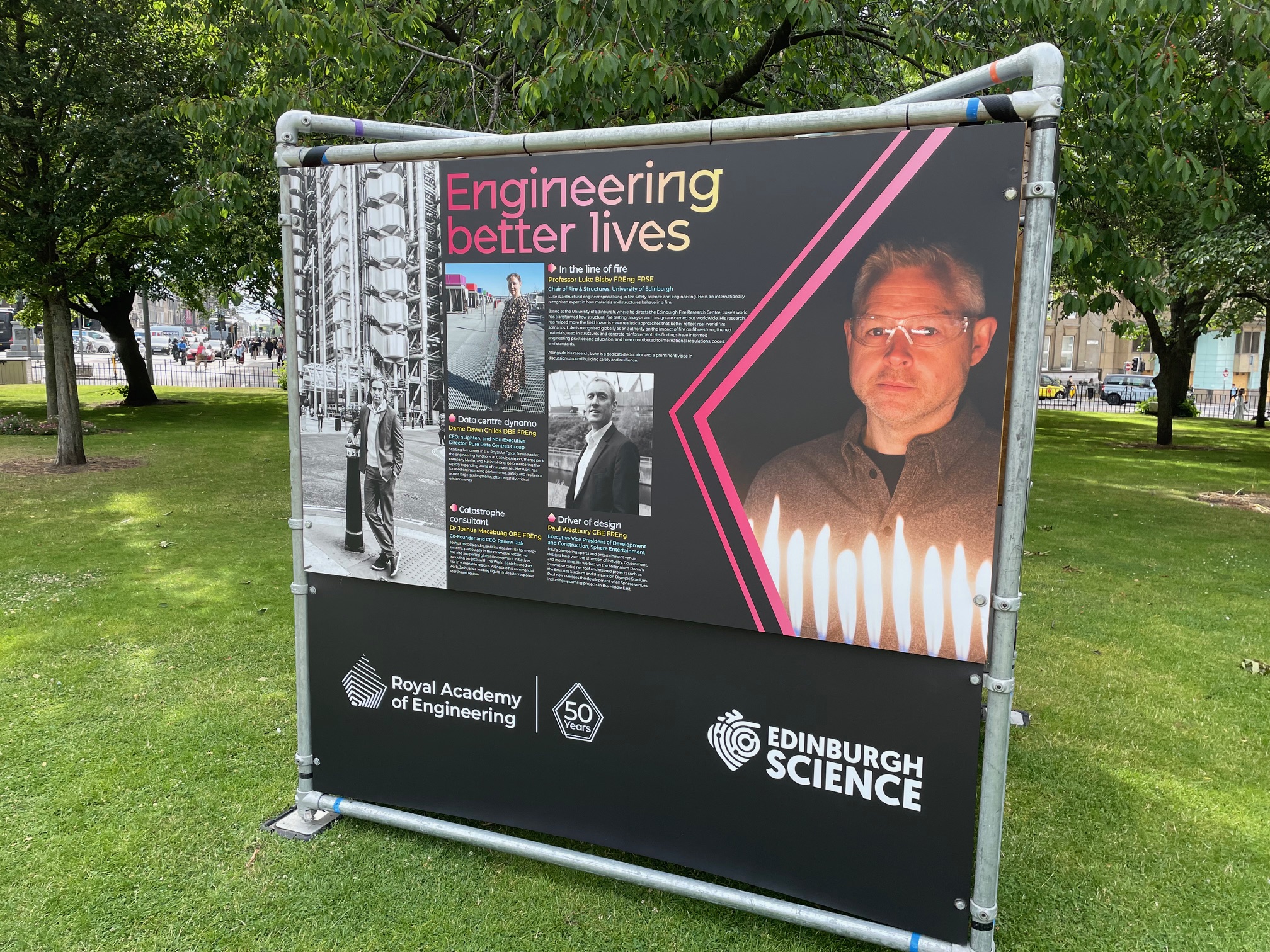
Engineering better lives for 50 years
Conceived during the excitement of the Apollo space programme and the buzz of Prime Minister Harold Wilson’s ‘white heat of technology’, the Royal Academy of Engineering was born in 1976, the year of Concorde’s first commercial flight.
The first 130 Fellows were some of the most brilliant minds of the time. They included the jet engine genius Sir Frank Whittle, design guru Sir Ove Arup, radar pioneer Sir George MacFarlane, bouncing bomb inventor Sir Barnes Wallis, and Sir Maurice Wilkes, father of the UK computer industry.
Today the Academy has over 1,700 Fellows and the boundaries of engineering have expanded more rapidly that anyone could have predicted 50 years ago. From optical fibre communications and artificial intelligence to engineering biology and graphene, engineers are changing the world.
Notes for editors
The Royal Academy of Engineering creates and leads a community of outstanding experts and innovators to engineer better lives. As a charity and a Fellowship, we deliver public benefit from excellence in engineering and technology and convene leading businesspeople, entrepreneurs, innovators and academics across engineering and technology. As a National Academy, we provide leadership for engineering and technology, and independent, expert advice to policymakers in the UK and beyond. Our work is enabled by funding from the Department for Science, Innovation and Technology, corporate and university partners, charitable trusts and foundations, and individual donors.