
Moving beyond ‘Talking At’ young people
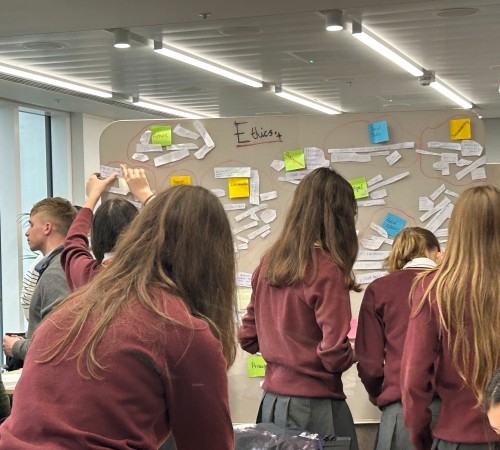
Students at IBM bringing together suggestions from over 700 worksheets to build the Charter for Ethical Innovation
While there is a growing recognition within the sector that engineering should be ethically principled and socially responsible, the views of the very people who will inherit these technologies, young people, are rarely collected or included in the debate. Maggie Philbin, CEO of TeenTech, notes that a common ‘bugbear’ in outreach is the tendency for experts to ‘talk at’ young people without truly listening to their perspectives.
“Nobody, or very few people actually listen to young people,” Maggie explains. "So, I thought, let's turn this on its head. We will ask young people for their views on ethical innovation. What really matters to them when it comes to a new gadget, a new service, or a digital project?”
The project brought together over 700 TeenTech students alongside more than 50 engineers to explore the ethics of decision-making and the trade-offs that occur during innovation.
Putting students in the driving seat
TeenTethics worked with students aged 10–18 from across the UK, including Inverclyde, Oldham, Cardiff, London, Leicester and Derby, prioritising schools in areas of high disadvantage. The project moved through four stages:
-
The programme began with professional development for the participating engineers. They received training in storytelling and communication, helping them communicate ethics and the ethical trade-offs.
-
Workshops took place in schools and colleges across England, Scotland, and Wales where engineers joined students in the classrooms helping them articulate ethics they wished to see underpinning innovation.
-
An event at IBM where 90 student representatives worked with engineers to analyse the data produced by 700 students in the workshops.
-
The culmination of this research was the Young Person’s Charter for Ethical Innovation. Students requested this to be a fully inclusive, living document, enabling young people to amend and develop the recommendations.
Edwin Colyer, founder of Scientia Scripta, was struck by the students’ ability to handle complex qualitative research. “They spent a day categorising all the ideas from hundreds and hundreds of worksheets,” Edwin continues. “Staff at IBM were equally impressed, noting that the students were naturally demonstrating design thinking without prior formal training.”
A reciprocal learning experience
The impact of the project was felt as much by the engineers as it was by the students. Edwin recalls that engineers were blown away by the level of maturity and the depth of thought the young people demonstrated about values like workers' rights and the environment.
Video interviews and an online survey reported 90 % of the engineers said the experience increased their knowledge on how to engage with students or the public by sharing ethical dilemmas. As one engineer said: “It’s the first outreach programme I’ve done but I felt like it was a big success.” Another wrote: “I’ve been really surprised by the ideas they’ve come up with and to see what’s important to them. I feel I’ve learned more than they have.”
For the students, feedback showed narrow preconceptions had been changed. As one student remarked: “I used to think engineers looked depressed, old, and always tired, also had no time for other things. My perspective changed both on engineers and the job of engineers. They also love life and the job is also very interesting.” Another said: “It might now be a career option for me. I’d like to do computer science GCSE. I’ve learned that engineering is not just about computers.”
A Lasting legacy
The project’s primary output, Young Person’s Charter for Ethical Innovation, is now a living document on the TeenTech website, enabling young people to continue to suggest amendments and indicate aspects they consider high priorities. They are delivering a powerful message to the world on their expectations for how those responsible for innovation should behave. The principles shared by students are embedded in the TeenTech Awards judging criteria.
The Charter was launched by students at the TeenTech Awards Showcase Day at the IET on June 28, 2024. Students explained it to the audience and invited students and teachers to find out more and suggest changes. As part of the launch, students explained the ethical values behind their charter and a vox pop video of students talking about ethics helped to make it real, so the charter was recognised for being more than just aspirational statements. On the Awards Day, student stands were given certificates recognising different ethical values underpinning their projects, so the thinking behind their work was immediately visible to all visitors.
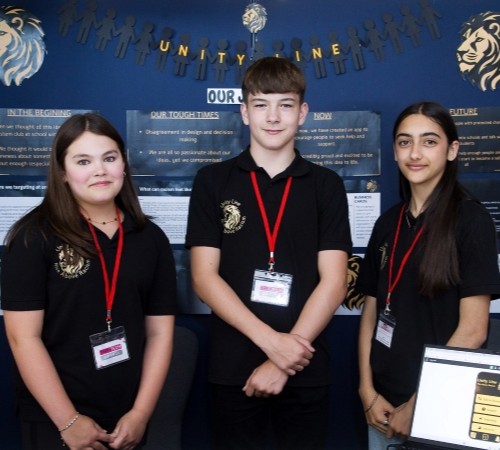
Finalists Bella, Jess and Tommy at the TeenTech Awards showing their project Unity Line designed to provide support to those who’ve experienced racism
Since then, over 12,000 students participating in TeenTech programmes have been challenged to consider the ethics underpinning designs and ideas.
“Ethical innovation is now completely baked into all our TeenTech activity,” says Maggie. “Beyond the awards, the project has empowered students to feel they are not just preparing for the future but actively determining what that future should look like.”
This was noted by an engineer at the TeenTech Awards who said: “The most meaningful and important part for me is the genuine diversity and inclusivity that you have instilled so deeply in TeenTech, and that comes out in all of the projects submitted, with each and every one aiming to make the world a better place for everyone. As I continue my career in the engineering/technology world, TeenTech is the benchmark for how the industry needs to be, and I will do all I can to enable that to happen.”
The students had a range of ideas for how the charter could be shared in the future - using animation, shortform videos over platforms used by young people and the TeenTech and Scientia Scripta are seeking funding to support this. “I really wanted to do something that wasn't just young people doing engineering or learning about it,” Edwin reflects on the project. “I wanted them to have a wider perspective on working well and having deep thoughts about what you're doing rather than just, let’s make another gizmo.”
Challenges and lessons
Early in the project, it became clear that many students did not understand what was meant by ethics. To address this, the team had to revise their delivery to include short films that illustrated ethical issues simply. They were also determined that the final charter should be in the students' own words. “It was hard to throw the process open and not interfere or suggest categories to the participants.” Says Maggie.
During the project, the team experimented with group sizes from 25 to 150. Then eventually found that smaller group sizes were significantly more effective for impact and enjoyment, even if it meant reaching slightly fewer students overall. While the team initially considered virtual methods for data analysis, they opted for a physical ‘old school’ event at IBM to handle 700 physical worksheets and ensure the process was transparent for the students to see themselves building this charter.
Advice for future Ingenious projects
Maggie suggests that future applicants should plan how they will shout about their project and increase visibility. “We had some local and national press coverage but launching the Charter in the middle of the General Election, meant compromises on timing.” She also suggests collecting as much data and feedback from people while they are with you. “This was one thing we did well, gathering not only impact data but video interviews with all stakeholders. It's so important you do this rather than rather than only relying on post-event surveys.” It is also essential to build enough time into the project schedule to try things out and make adjustments based on what is or isn't working.
Watch a year of TeenTethics with stakeholder interviews
More stories

Engineering Meets Dance
Brought together engineers from the University of Leeds, artists from Northern Ballet, educators, and young people from Batley Girls’ High School to explore the mechanics of movement through dance.

Engineering, animated by the next generation of engineers
ENGAGE: Engineering Animations Engagement, led by Cardiff University, supported engineers to share their stories and passion with pupils in primary schools in South Wales as part of a series of workshops in animation.